

Bible studies are the heartbeat of women’s ministries in many churches. More and more churches have come to prefer live teaching over video studies. But this can present a challenge for women’s ministry directors: Where do we find teachers?
Bible teachers don’t come ready-made. We have to raise them up through training. Whether women have never taught the Scriptures before or are building on previous experience, we can help them grow and gain confidence in “rightly handling the word of truth” (2 Tim. 2:15) through careful instruction and practice.
To equip women in my church to teach, I helped develop a four-session course. Here’s how we developed and implemented this training.
Get Organized
I first recruited two women with experience teaching the Bible, and together we prepared ourselves as instructors by taking the online Simeon Trust First Principles for Women course. We then personalized the principles we learned to fit our training goals for other women in our church.
Since there are different strategies for approaching various genres of Scripture, the first time we held this course, we chose to train women on how to teach an epistle. We selected 1 Peter as our text and assigned each group a passage to work on throughout the course.
For example, Group 1 had 1 Peter 1:1–12, Group 2 had 1:13–21, and Group 3 had 4:12–19. We used 5:1–11 as a common passage that we studied as a whole group. In subsequent courses, we chose other genres of Scripture: narrative using passages from a Gospel and wisdom/poetry using a psalm.
Bible teachers don’t come ready-made. We have to raise them up through training.
We promoted the training with a clear purpose: to help participants grow in their ability to understand and teach God’s Word. We spelled out our expectations: attending all four sessions, completing homework, and teaching a 10-minute message to peers.
Individual attention in training is key, so we assigned each participant to a small group of three to six women with a leader. The leader gave feedback on homework and answered questions.
Teach the Course
Here’s what we covered each week, including teaching content, small-group work, and homework assignments.
Week 1: Foundations of Study
After sharing two foundational truths about the Bible—Scripture is God-breathed (2 Tim. 3:16–17) and Scripture is alive and active, changing us as we study it (Heb. 4:12)—we taught three principles.
First, we never add to or subtract from what’s written in the Word (Deut. 4:2; 1 Cor. 4:6; Rev. 22:18–19). A Bible text isn’t a jumping-off point to give our insights. We must be diligent to stay faithful to the Holy Spirit’s intended meaning. We strive to “stay on the line” of Scripture, never going above it by adding to it (which can result in undue speculation or legalism) or going below it by taking away from it (avoiding unpleasant or confusing passages, or altering the meaning to what we want it to mean).
Second, the Bible is one big story, with one Hero of the story (Luke 24:27). From Genesis to Revelation—creation, fall, redemption, and restoration—we see God at work to reconcile people to himself. The Old Testament points to our need for and anticipation of a Savior, and the New Testament records and reflects on that Savior. Understanding this one big story helps reveal the significance of each passage.
Third, context is king and questions are key. Context is the setting in which something occurs, and it always guides our interpretation. We consider both the literary context (what comes before and after a passage) and the historical context (the situation in which the original audience found themselves). To “stay on the line,” asking in-depth questions of the passage is vital, so we introduced the participants to questions for an epistle.
In small-group time, we had each woman read the group’s assigned passage aloud because a thoughtful reading aids understanding, as does hearing the passage multiple times. For homework, we asked the women to list 15 observations from their small group’s passage along with 15 observations from the common passage.
Week 2: From Text to Talk
We started in small groups with each woman sharing her observations on her group’s designated passage. Then we had a whole-group discussion of observations found in the common passage.
This week’s teaching focused on how to go from observing a Scripture text to preparing to teach it to a group of real women.
We first explained exegesis—analyzing Scripture to draw out its intended meaning. We walked the women through how to use the questions for an epistle to understand the passage’s meaning to the original recipients. We always look for the main idea, the immediate context (passages before and after in the book), the historical context (names, places, situations, other passages that may explain this one), and the biblical context (Where does this fit in the bigger story of the whole Bible?). A concordance is a valuable tool here.
We then helped participants find the connection to the gospel (Luke 24:25–27). We taught them to look for related themes (e.g., hope, forgiveness, sacrifice, priesthood) and typology (people, objects, or events patterned after Jesus like Joseph, Boaz, David, or the ark). The Jesus Storybook Bible can be a great help in revealing these connections.
Finally, we taught the women how to draw out applications. The main idea doesn’t change because of the audience, but the particular applications may. We emphasized knowing your audience by thinking through where the listeners are spiritually, what sin issues or struggles they have, and what encouragement they need. We reminded the group of the purpose of our messages: to have women’s affections stirred by the Spirit so they’re personally affected by the truth of the text.
For homework, each woman identified an audience for her teaching specifying age, life stage, and specific needs and struggles. Then, using her assigned passage, she recorded the main idea, the significance to the original hearers, the connection to the gospel, and an application specific to her target audience.
Week 3: Structure and Illustrations
In small groups, women shared their homework and instructors gave feedback. While it’s time-consuming for each woman to share, everyone benefits from hearing each other’s work on the same passage.
We began this week’s teaching by explaining two common mistakes teachers make: (1) sharing what “touched us” in a passage, unrelated to the main idea, and (2) having so many points that they obstruct the main idea. To avoid these mistakes, we discussed the importance of structure.
The process of finding a text’s structure varies depending on its genre, so we briefly explained how to go about determining the “shape” of three genres: epistle, narrative, and poetry. Since we were learning to teach an epistle, we spent the most time on this, helping the women focus on the words and grammar.
We taught them to look for “bookends” (similar words at the beginning and end of a paragraph or book); repeated words, phrases, or ideas; connecting words like if/then, because, therefore; grammar and verb tenses; and words that reveal the context. All these help uncover the author’s main idea or emphasis in a discourse. We then took time to practice identifying these elements in small groups using the common passage.
A Bible text isn’t a jumping-off point to give our insights.
To close week 3, we introduced illustrations. We explained their purpose (to serve the main idea and application and make the teaching clearer) along with various illustration types and where to find them. We suggested using stories, analogies, word pictures, and examples from personal experiences, books, movies, history, current events, and nature.
For homework, we asked the women to develop a teaching outline and an illustration for their passage.
Week 4: Preparing a Talk
The final week began in small groups with each member sharing her teaching outline and illustration. Participants compared their work and encouraged each other.
Our teaching focused on how to prepare a talk, beginning with crafting an argument. We taught the skill of stating the main point of the text in a persuasive, memorable way. We wanted the women to convince their audience of the truth and importance of the text, showing it to be relevant, meaningful, and life-changing. For effectiveness, we encouraged them to use this argument (or parts of it) throughout their talks because repetition helps retention.
Next, we discussed how to arrange material to explain the passage clearly and memorably, with each point flowing from and supporting their argument, using the words of the text whenever possible.
Finally, we instructed them to include an illustration to clarify or contextualize their argument, then tie it all together with an attention-getting introduction and a main idea–centered conclusion.
Practice the Skills
At the end of our time, we set meeting dates for each group two to three weeks out. When her turn came, each woman stood before her small group and gave a 10-minute talk. She read the passage aloud, then presented her message, which included an introductory sentence, a description of the context, the main idea and a persuasive argument, supporting points, an illustration, an application, and a conclusion.
We instructors heard every woman teach, listening attentively, timing her talk, and offering one suggestion for improvement. Group members gave each other positive feedback on their content. We were all impressed with the quality of the messages and the deep wisdom from God that the women were able to communicate in only 10 minutes.
We have women in our churches who can teach the Bible, if only we’ll train them. You can follow this course outline or develop one of your own. Our churches need women to teach the Word, but we shouldn’t expect them to equip themselves. Let’s be diligent to prepare women for this vital role.
Get ‘The Weary World Rejoices’ Advent Devotional for FREE
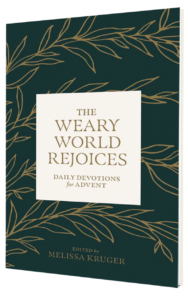
Are you dreading a hectic December? Do you wish your weariness could give way to quiet contemplation of the meaning of Christmas? If so, we’re delighted to offer a FREE Advent devotional that can help. This daily devotional is written by TGC’s editorial staff—Winfree Brisley, Courtney Doctor, Melissa Kruger, Collin Hansen, Megan Hill, Betsy Childs Howard, Brett McCracken, Ivan Mesa, Matt Smethurst, Sarah Eekhoff Zylstra, and more!
We’re delighted to offer you the digital version of this Advent devotional for FREE today. If you or someone in your life needs to be reminded of the light of Christ at this time of year, click on this link to receive instant access today.