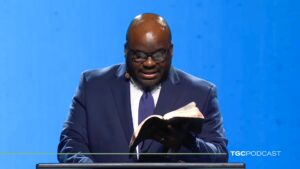
Listen or read the following transcript as D. A. Carson speaks on the topic of New Birth from John 3:1-21
About 15 years ago, the Datsun automobile changed its name. The parent company, Nissan Motors, of Japan, decided that henceforth the base name for its cars would no longer be Datsun, but Nissan. In North America, at least, this change was accompanied by endless advertisements about “the born-again Datsun,” and thus born-again entered the mainstream of American vocabulary. Pretty soon it was cropping up everywhere.
If a politician changed parties, for example, then one spoke of a born-again Republican, or one can think of one or two examples in this country where one might analogously speak of a born-again liberal Democrat. Then in the press the term was associated with the religious right, so that the press often spoke rather condescendingly and sneeringly sometimes of born-again Christians; that is, as opposed to other Christians. There were Christians, and then there were born-again Christians, and the born-again Christians are the kooks.
It is not much defined beyond that. So what is born-again to be understood to mean? Does it signify a change of name, a change of mind, or that someone is a religious nutter? So far as we know, the expression was first coined by Jesus himself, and the first person who heard the expression, Nicodemus, didn’t make much sense of it either, but it is profoundly bound up with what the Bible says about the Holy Spirit. It may help us to follow this text by dividing it into four parts.
1. What Jesus said about being born again.
This is in the first 10 verses. In verse 1 Nicodemus is introduced to us. We are told he is a man of the Pharisees; that is, he belonged to a religious party that was pretty widely respected. It was conservative, much constrained by questions of purity. It was widely viewed as holy. Undoubtedly it bred its fair share of hypocrites but was broadly respected and often learned.
In addition, we are told, he was a member of the Jewish ruling council. The superpower at the time, of course, was Rome, but Rome’s policy was to provide an umbrella and, provided the member states of the empire did not exert too much independence, to allow the locals to get on with it. In Israel what that meant was executive, legislative, and judicial branches were all embraced in the Jewish Sanhedrin, so to be a member of that 70-member body was to be at the top level of society.
There is good evidence as well, extrabiblical evidence, that Nicodemus belonged to one of the three largest landowning families of the time, probably rich, and in verse 10 he is described as Israel’s teacher, almost certainly a title. That is to say, the Teacher of Israel, the Regius Professor of Divinity, the Grand Mufti. So he was, in other words, not merely any run-of-the-mill Pharisee but a learned scholar in the Scriptures, politically powerful, and at the same time probably well-to-do.
He approaches Jesus at night. There have been all kinds of theories spun over why he did that. Perhaps he was afraid of what the crowds would think of him, he, the Regius Professor of Divinity, approaching an itinerant preacher from the North. But when you read on in this book and find out a little more about Nicodemus’ character, you discover that he is not frightened of anyone.
This chap, whatever else he is, is not a wimp. Later on he’ll take on the Sanhedrin. A little farther on, he’ll go and confront the Roman governor himself about the body of Jesus. He’s prepared to stand up for whatever he thinks is right at the time. There’s not a shred of evidence to make us think that he was hiding his colors under the shade of darkness.
No, John is a writer who loves symbol-laden language, and he gives us a hint what he means by this in the passage itself. Look down at the end of it. Verses 19–21: “This is the verdict: Light has come into the world, but men loved darkness instead of light because their deeds were evil. Everyone who does evil hates the light, and will not come into the light for fear that his deeds will be exposed. But whoever lives by the truth comes into the light, so that it may be seen plainly that what he has done has been done through God.”
As early as the prologue and carrying on throughout the book, John plays with this light-dark contrast, so for whatever reason Nicodemus came to Jesus at night, and John, reflecting on the incident afterward, puts it in because he understands from the narrative, from what actually happened, that Nicodemus was embedded in a night far darker than Nicodemus thought at the time himself.
That’s made clear by the initial exchange. He approaches Jesus with a certain respect. “Rabbi,” he says. Essentially, after this Rabbi became more or less equivalent to our Reverend. It meant you were ordained. You were done. But in the first century, it was an entirely unofficial sort of title, so for the Regius Professor of Divinity to approach an itinerant from Galilee as Rabbi was already a mark of fair courtesy.
Yet he approaches Jesus with this comment. “We know you are a teacher who has come from God. For no one could perform the miraculous signs you are doing if God were not with him.” In every age there are religious charlatans. There are always people around who will perform psychosomatic miracles, but the kind of thing Jesus was doing was so unambiguously and so transparently miraculous that Nicodemus, for all of his education, for all of his sophistication, for all of his intellectual skepticism, had come to the conclusion that he was something special.
With a slightly pompous tone in the first-person plural, he says, “Rabbi, we know that you are … whatever else you are … a teacher come from God, for the kinds of things you are doing, no one could do unless God were with him.” Now how does Jesus respond? Verse 3: “I tell you the truth, no one can see the kingdom of God unless he is born again.”
Now on the face of it, the comment and Jesus’ response don’t mesh, so as a result people have concocted many clever suppositions about what was really going on here. Maybe this is a rather condensed version. Maybe what Nicodemus really said was something like this: “Rabbi, we know that you are a teacher sent from God, for no one could do the miracles that you are doing unless God were with him. So then, are you the Messiah who is to introduce the kingdom, or are you not?”
Jesus then replies, “I tell you the truth, it’s more important to understand the qualifications for entering the kingdom than anything else, and unless you’re born again you can’t get in.” Well, I suppose that makes sense, but in that case John really does make a bit of a mash of it as he records this, doesn’t he? It’s not what the text says.
Others think Jesus, here, is responding to the question that Nicodemus is about to articulate. Nicodemus begins, “Rabbi, we know that you are a teacher sent from God, for no one can do these miracles that you are doing unless God were with him.” And then he’s about to say, “So tell us then, are you here to introduce the promised kingdom or not?”
But Jesus can’t let him finish. He already knows where the question is going, and he immediately turns the discussion in the direction that he wants. What that presupposes, of course, is that Jesus is one of these rude people who can never let you finish a question before he answers it. No, in fact, the connection is very tight, and it needs to be understood.
Nicodemus is claiming to see God’s power at work. The notion of kingdom was bound up with authority. It was king-dominion. It was kingly reign. What Nicodemus was claiming to see in the miracles was God’s transforming kingly reign at work. “This is what we see in you. We have come to this conclusion.”
Jesus turns around and says, “My dear Nicodemus, you don’t see a thing. You can’t see the kingdom unless you’re born again. Oh, you may see the miracles. You see the effect, but you do not really see the kingly reign of God unless you yourself are transformed.” In other words, what Jesus is doing is pricking Nicodemus’ pretensions immediately, and he will do so even more strongly a little later on in the chapter, as we’ll see. Nicodemus replies, “How can a man be born when he is old? Surely he cannot enter a second time into his mother’s womb to be born!”
Now it may be that Nicodemus found Jesus’ teaching a little incomprehensible, but he was no fool. You don’t get to be the Teacher of Israel, you don’t get to be the Grand Mufti, the Regius Professor of Divinity and fail to discern the odd metaphor that comes along. I find it very hard to believe that Nicodemus actually thought Jesus was suggesting that the only way you can see the kingdom of God is to re-enter your mother’s womb and come out again.
No, the issue is much more profound. Most conservative Jews in Jesus’ day longed for the coming of the kingdom. When the kingdom comes, when God comes with power, then the ancient Davidic dynasty will be restored. Then there will be righteousness and justice in the land, and in the best exemplars of this vision, this would be a worldwide sweep with the nations gathering to worship the living and true God at Jerusalem. In this light, Jesus is saying something beyond that.
What we need is not simply the dawning of this expected kingdom but new people. What we need is new men and new women, not new institutions; new lives, not new laws; new creatures, not new creeds; new people, not mere displays of power. You can raise the whole Davidic dynasty all over again, but if you still have the same people it will end up the same way that the Davidic dynasty ended up the first time. You have to change people, and how do you generate new people?
Most of us have felt that pressure sometimes, haven’t we, if we have any moral sense at all? Have we not sometimes woken up in the middle of the night and remembered the time when we did such and such; or we said such a stupid, cruel, cutting thing; or we were unfaithful; or we lied; or we cheated and got found out; and.… Yes. Yes, if we’re Christians we know we’ve confessed it to God, and we know he forgives us, but whenever we think about that we squirm and writhe inside.
If you’ve never had an experience like that, quite frankly you’re morally dead, and if you’re not morally dead and have had some experiences like that, cheer up; you’ll have more of them as you get older. Alfred Lord Tennyson wrote, “Ah, for a man to arise in me, that the man I am may no longer be.” The poet John Clare said, “If life had a second edition, how I would correct the proofs.”
But the fact of the matter is you can’t do it. You only live this way once. No second editions. “Jesus, you’re promising a bit much. The Scriptures promise the dawning of the kingdom, but new people? You can no more generate new people, you can no more say that you must be born again than you can say you go back into your mommy’s tummy and come out again.” That’s what Nicodemus is saying. “How can a man be born again? How can you start over? It can’t be done.”
But Jesus won’t back down. Hence verse 5: “I tell you the truth, no one can enter the kingdom of God unless he is born of water and the Spirit.” Now what does that mean? Some people think that this means you have to be born naturally, of water, and be born spiritually, of spirit. Maybe the water refers to the amniotic fluid that bursts from the sac before the baby actually is born. But in all of the ancient literature, Greek and Latin and Jewish, nothing to my knowledge ever refers to natural birth as born of water. It’s not the symbolism of the ancient world.
Others think this refers to Christian baptism, but strictly speaking, Christian baptism, in a full-orbed sense, isn’t really invented yet, and there’s something more important yet. In verses 9 and 10, Jesus finally bawls out Nicodemus for not understanding these things. On what basis does he think Nicodemus should have understood these things? Is it not on the basis of the fact that he was the Regius Professor of Divinity? Whatever else he knew, he knew the Scriptures.
“You’re the Teacher of Israel, and you don’t know these things?” Not too surprising if he’s not too clued-in yet on Christian baptism, but it is quite shocking if he hasn’t found things in the Scriptures of which he is an expert. Then there’s another clue, and it’s decisive. Compare verse 3 and verse 5 line by line. Read them out.
Jesus says in verse 3: “I tell you the truth.” Verse 5: “I tell you the truth.” Verse 3: “No one can see the kingdom of God.” Verse 5: “No one can enter the kingdom of God.” Small change. Verse 3: “Unless he is born again.” Verse 5: “Unless he is born of water and the Spirit.” In other words, the parallelism between these two verses suggests that being born of water and the Spirit is entirely parallel to being born again, and that this being born again or that this begin born of water and the Spirit comes about, in fact, from something already predicted in Scripture.
What is it? Well you can read the Old Testament high and low and look for the expression born again and you will not find it, but the primary reason why Jesus changes the terminology here from again to water and Spirit is so that Nicodemus should pick up the clue. Water and Spirit are linked in the Old Testament in a number of passages, but perhaps the most important is Ezekiel 36. It’s one of the new covenant passages that describe what will take place on the last day.
In addition to those passages that spoke of a dawning kingdom when God would return with justice and finally put the world to right, there were passages in Jeremiah 31 and in Joel 2 and in Ezekiel 36 that describe a time when God would come down and write his law on the hearts of the people, take away their stony hearts and give them hearts of flesh, or, to change the metaphor, pour out his Spirit upon them so that they would all know him.
In so much of the old covenant structure of religion (that is, the time before Christ) the entire relationship between God and his people was a mediated relationship. God spoke through prophets and priests and kings who dispensed the Word to others. God came upon them with great enduement and power, but God says, “The time is coming, under a new agreement, a new covenant, when I will write my law on all of their hearts.”
That is, “All within the covenant will know me, from the least to the greatest, men and women, young and old, Jews and Gentiles. I will sprinkle them with clean water.” That is a symbol signaling that that they would be cleaned up. “And I will pour out my Spirit upon them, so that they will truly know me.”
They will have something of the life of God within them, but those sorts of passages were by and large overlooked by the learned rabbis of Jesus’ day. There was so much focus on the dawning of the kingdom that this life-transforming set of passages tended to be overlooked, so Jesus gives it some further explanation, two quick illustrations in fact.
First, verse 6: “Flesh give birth to flesh, but the Spirit gives birth to Spirit. You should not be surprised at my saying, ‘You must be born again.’ ” That is, like breeds like. Robins give birth to baby robins, eggs first and then robins. Pigs give birth to pigs. I have never yet seen a porcupine generate a kangaroo. Like breeds like, and sinful human beings in rebellion against God breed sinful human beings in rebellion against God.
We are a lost race. Flesh breeds flesh. What we need is a new origin, a new life, a transforming power, a new generation, a regeneration. Then to change the metaphor, he says, “The wind blows where it pleases. You hear its sound, but you cannot tell where it comes from or where it is going. So it is with everyone born of the Spirit.” Now it works a little better in both Hebrew and Greek than in English, because the word for spirit is also used for breathe or wind, but what is meant is pretty clear, in any case.
Perhaps they’re standing on a street corner in Jerusalem. The wind whistles around one of the mud houses. Perhaps a little dust devil dances down the street, or perhaps it’s beginning to brew up a storm. No one sits around and thinks, “Aha! There’s a high in the Arabian Desert. There’s a low in the Mediterranean.” They knew even less about meteorology then than we do now, but no one denies the effect of wind.
You can’t deny the effects, even if you can’t explain all the mechanics. So it is with everyone born of the Spirit of God. When people are genuinely transformed by God, they change. Their values change. Their orientation changes. What they trust changes. They love things they didn’t used to love. They despise sins that they used to revere and cherish and nurture. Now they’re beginning to set their affections on things above, not on things on the earth.
They’re no longer bound by the merely temporary and material. They’re changed people, and you meet such changed people and you might produce all the explanations that you can trot out. “Well, they belong to a certain interpretive community.” “Well, it’s what happens when you become a religious fanatic.” “They’ve gone over the top reading their Bibles a bit much recently.” Or if you’re 18, I guarantee someone in your family will say, “It’s just a phase.”
But sooner or later, when you see someone born of God, you might not be able to explain the mechanics, but you can’t deny the effect. That’s what Jesus says. You spot them. “How can this be?” Nicodemus asks. “You’re Israel’s teacher, and do you not understand these things?” That’s what Jesus says about being born again. Now more quickly …
2. Why could Jesus speak about being born again?
Verse 11–13. Verse 11 finds Jesus speaking in the first-person plural. “I tell you the truth, we speak of what we know, and we testify to what we have seen, but still you people do not accept our testimony.” Why this first-person plural? Some have thought, “Well maybe Jesus was referring to himself and his disciples.” But if you read the adjoining chapters, you discover that at this early point in Jesus’ ministry, the disciples are not too clued-in.
Others think this is proof-positive of anachronism. That is, this is not historically the way it was. This is a mistake. The later church is being read back into the text. Oh, but that’s just too clever by half and presupposes that John was a bit of a twit when he was writing; couldn’t keep his time straight. There’s a much simpler explanation.
Jesus is still gently, with a bit of quiet humor, pricking the pretensions of Nicodemus. How would Nicodemus come to Jesus? I imagine he’d likely clear his throat and then say, “Rabbi. We know that you are a teacher sent from God, we do.” “Yes. Well, as a matter of fact, I tell you the truth. We speak of what we know, too, we do.” And it isn’t merely theological one-upmanship. That would just be a cheap game. There is an important issue at stake. Having pricked the pretensions, he reverts to first-person singular and shows what is at stake.
“I have spoken to you of earthly things and you do not believe; how then will you believe if I speak of heavenly things? No one has ever gone into heaven except the one who came from heaven—the Son of Man.” Do you see what Jesus is saying? “You’re finding it hard to swallow what I say when I’m talking about earthly things.”
Now, they’re heavenly in origin, they come from the Spirit of God, but they’re earthly in the sense that they take place here on earth, amongst men and women, now. “They’re earthly things, and you’re finding it hard to accept them. Now supposing instead I described to you the glories of the throne room of God. Would you be a little more open?” No, the truth of the matter is, Jesus says, “The issue is revelation.” Revelation.
“No one has gone into heaven.” That doesn’t mean that no one from the past has ever gotten there. It means no one has ever gone there to check it out and come back and tell us. The only one who has done that is the one who came from heaven—the Son of Man, one of Jesus’ favorite self-designations. What is at stake is an authority issue.
Have you met people who sometimes say, “Well I can’t quite believe in that sort of God. The god I can believe in would look like so-and-so, so-and-so. Drop out this one, as it’s a bit uncomfortable, and that attribute’s a bit hard to swallow, and it’s a bit intolerant over here.… Now over here, if you take some attributes and some attributes here and put them together, that’s a god I can believe in.”
In the postmodern society, that’s an extremely popular way to proceed. You generate your own god. It’s much more important to be religious than to claim there is one true religion; that’s a mark of intolerance. Your beliefs can all, finally, be charted up to the interpretive community you belong to. Are you doubting the sincerity of neighborhood Muslims? Quiet, pious Hindus? Why not accept the god you can believe in and then make him comfortable, too?
But however many pressures there are in our society for that kind of democratically voted-in god, it’s not the God of the Bible, and it’s not what Jesus taught. No one has ever gone into heaven to sort of check things out and bring back a report. The only way we have access to this sort of information is revelation, the Son of Man who came from heaven.
Hence, in the opening chapter, “The Word,” God’s self-expression, “became flesh, a human being, and lived for awhile among us, and we beheld his glory.” At the end of the day, as long as people are still saying, “This is the kind of god I can believe in,” they are still making themselves god. They are defining the characteristics. They are defining who is qualified to be God, and at one level Nicodemus is guilty of precisely that point.
He is prepared to stand in judgment of Jesus because he is not simply checking him out to see if he’s authentic but wants to remain at a level of assessment. That is why his pretensions need to be pricked. At the end of the day you do not stand in judgment of Jesus; he stands in judgment of you. You cannot come to terms with basic Christianity until you come to terms with the Jesus who reveals God. You cannot do it.
3. How, then, does Jesus bring about this new birth?
Verses 14 and 15: “Just as Moses lifted up the snake in the desert, so the Son of Man must be lifted up, that everyone who believes in him may have eternal life.” Now, that may seem a strange way of proceeding for us, because many of us don’t know our Bibles the way first-century Jews did, especially a learned man like Nicodemus, but this was a very telling analogy for him, because he knew his Bible stories so well.
The account is found in Numbers 21. It’s only a few verses long. It takes place at the time when the people of God were traveling through the desert. They’re growing restive and impatient again, and they speak (verse 5), against God and against Moses and say, “Why have you brought us up out of Egypt to die in the desert?” They’ve been released from slavery, but as far as they’re concerned, they’re about to die.
“There’s no water. There’s no bread. There’s not enough to sustain us.” Then what God had provided for them, this miraculous manna which fed them, “ ‘We detest this miserable food!’ Then the Lord sent venomous snakes among them; they bit the people and many Israelites died. The people came to Moses and said, ‘We sinned when we spoke against the Lord and against you. Pray that the Lord will take the snakes away from us.’
So Moses prayed for the people. The Lord said to Moses, ‘Make a snake and put it up on a pole; anyone who is bitten can look at it and live.’ So Moses made a bronze snake and put it up on a pole. Then when anyone was bitten by a snake and looked at the bronze snake, he lived.” That’s the whole account. It is a flat-out miracle, but it has some telling parallels with what’s going on in John 3.
There, too, the people were wanting to stand in judgment of God, so Nicodemus was wanting to stand in judgment of Jesus. There the people didn’t like the rescue that God had provided, so Nicodemus was not too clear he wanted the vision of the kingdom that Jesus was providing. There there was judgment because of it, and the solution came with something God provided. The people merely needed to repent of their wickedness and look at the solution God had provided, this bronze snake on a pole.
Jesus says, “Now just as that happened, just as Moses lifted up the snake in the desert and people then were saved from the judgment they were facing, so the Son of Man, I, must be lifted up, that everyone who believes in him may have eternal life.” One of John’s repeated literary devices as he writes this book is to introduce a theme which is unpacked later.
Later this expression, this lifting up, is unpacked progressively until in chapter 12 it’s very, very clear that the lifting up of Jesus is lifting him up on a cross to die, the just for the unjust, to bring us to God, and if people are to escape God’s judgment they must look to the one who is lifted up on this new pole, this Jesus who dies that others may live.
That is the solution. That is the object of faith, that everyone who believes in him, in him who is lifted up on a pole, who dies for us, may have have this eternal life; that is, may know this wind of the Spirit and may be born again. That brings us to the last point.
4. Why, then, was Jesus sent to bring about this new birth?
“For God so loved the world that he gave his one and only Son.” Now it is very important to get this right. Somehow we have come to the position, in our Western world, whereby we think that the love of God is an easy thing to believe and the wrath of God is a hard thing to believe. Three centuries ago in this country it was the reverse.
Everybody believed that God was a God of honor and integrity and justice and, therefore, also a God of judgment. To believe that God was really a God of love, that was a little harder to swallow, but today we’ve come to the position, by and large in our culture, where we think that if there is a God, then he’s a sort of grandfatherly figure who really can’t turn away from such nice people as we are.
A few years ago I was studying in Germany trying to improve my German, and there was another fellow there with me whom I got to know in this course from French West Africa, and because I was reared in French Canada and could speak French fluently, whenever we got tired of German we would go off and have a meal together and rattle away in French.
As we did this once or twice a week, eventually I discovered that he had a wife here in London who was pursuing doctoral studies while he was improving his German to work in doctoral studies in engineering. I also discovered, within a few weeks, that two or three times a week he was going down to the red light district in town and paying his money and having a woman.
As I got to know him a little better I said to him, “Supposing you found out your wife were doing something similar in London, what would you do?” He said, “Oh, I’d kill her.” I said, “Well that’s a bit much, isn’t it, a bit of a double standard?” He said, “You don’t understand. In the tribe from which I come men are allowed to sleep around and women aren’t. If she did that, she would be dishonoring me. I would kill her.”
I said, “But you tell me that you were reared in a mission school where you don’t play around with double standards. God doesn’t grade on the curve. Sin is sin, whether you’re a man or whether you’re a woman. If sin is sin for her, sin is sin for you. How can you say such a thing as that?” “Ah, le bon Dieu; il doit nous pardonner; c’est son mÈtier. God is good. He’s bound to forgive us. That’s his job.”
We might not be so crass, but deep down that’s what many of us think. An illustration I sometimes used with students in this regard concerns Paul and Gail, shall we say? Paul and Gail have just graduated from university. They’re walking down a beach hand-in-hand. They’ve been growing closer together over the last year or two.
They kick off their sandals and let the warm sand ooze through their toes. In the background is the setting sun, so they’re on the West Coast somewhere. There’s a setting sun with all the glory of the screen credits of a Cecil B. DeMille film. Paul turns to Gail and he says, “Gail, I love you. I really do.” What does he mean?
It’s not obvious. He might mean any one of several things. He might simply mean that he wants go to to bed with her. He might, but if we assume he’s got some modicum of decency at all, the least that he means is that he finds her so lovely that he cannot imagine life without her. Part of his declaration of love is a declaration that to him she is lovely.
Whenever he thinks of her, the sweet smell of her hair, the happy release of her laughter, the warmth of her smile, she is lovely. He certainly does not mean, “You have the worst case of halitosis I have ever smelled! Your hair is as greasy and stringy as I have ever imagined. The most amazingly bulbous nose decorates your face, but I love you.”
Now God comes along and he says, “I love you.” That’s what the text says. “God so loved the world.” What does he mean? Does he mean, “World, you are so adorable to me, I can’t imagine existence without you. The sweetness of your praise and the integrity of your ways, the gentleness of your steadfastness and the fidelity of your charms.… My, I couldn’t exist in eternity if I didn’t have you”?
Biblically speaking, God loves us despite the fact that morally we’re the people of the halitosis, the stringy hair, and the bulbous nose, and God loves us simply because he’s that kind of God. Isn’t that what the text says? “God so loved the world.” In John the world is not a big place so much as a bad place.
What’s wonderful about God’s love is that he loves this world in rebellion against God. He loves it though he doesn’t owe us anything. He loves us when we’ve shaken our puny fists in his face and sung with Frank Sinatra, “I did it my way,” when we were made by him and for him. He loves us anyway, because he’s that kind of God. Isn’t that what the text says.
“For God did not send his Son into the world to condemn the world.” You see, the assumption is that the world should be condemned. That’s what you might have expected this God to do, to come and condemn us, but he didn’t do that. “… but to save the world through Christ.” Verse 19: “This is the verdict: Light has come into the world, but men loved darkness instead of light because their deeds were evil.”
Very often the reasons why people don’t close with Christ and really come to know him is not because of the supreme intellectual difficulties of faith, but because they won’t give up sleeping around, or because they will not bend the knee and say, “Not my will, but yours be done.” Or because they don’t really want a religion in which they find that God really is at the center, not some powerful genie in a bottle who pops out when we rub the bottle, but it is we who rub the bottle.
God is at the center. He has the praise. He has the rights. He lays down the law, and he saves! He pours out the Spirit. He gives new birth. He transforms. He saves. What he wants of us is that we abandon ourselves to him, that we repent and believe. That’s what belief, finally, in John is, a self-abandonment to Christ and his words and his way, trusting him because he takes our guilt and dies in our place, disclosing God to us. That is why Christ was sent to bring us new birth.
Now I am going to close in prayer, and I’m going to tell you, first, what I am going to pray. I’m going to pray a prayer that would be particularly suitable if you have never yet closed with this Christ, never trusted him, never come to know him, never experienced this new birth for yourself. I will pray it slowly enough so that you can pray it in your own mind after me, and this God, who is a talking God, likes to hear us talk, and will read your prayer. Let me tell you what the prayer is.
I shall pray, “Almighty God, I have lived for myself, wanting my own way, in rebellion against you. I am sorry about that. I’ve come to see that you love me, that Jesus died for me, that the Spirit alone gives new birth. Please forgive my ugly rebellion. Please change me by this new birth so that I may love your ways. For Jesus’ sake.” Now let us pray.
Almighty God, I have lived for myself, wanting my own way, in rebellion against you. I am sorry about that. I’ve come to see that you love me, that Jesus died for me, that the Holy Spirit alone gives new birth. Please forgive my ugly rebellion. Please change me by this new birth so that I may love your ways. For Jesus’ sake, amen.